Everyone who sketches has a love of pens. We all have a collection of our favorites, the ones that feel right in our hand. I’ve certainly laid down a lot of miles with my personal trifecta: a ballpoint, the Lamy Safari, and the Pentel Pocket Brush (replaced these days with the Kuretake #13 plus Sable tip add-on).
But.
I think I might be ready to retire my manufactured pens, in favor of dipping nibs. These little tin nibs are just so flexible. (Pun intended).
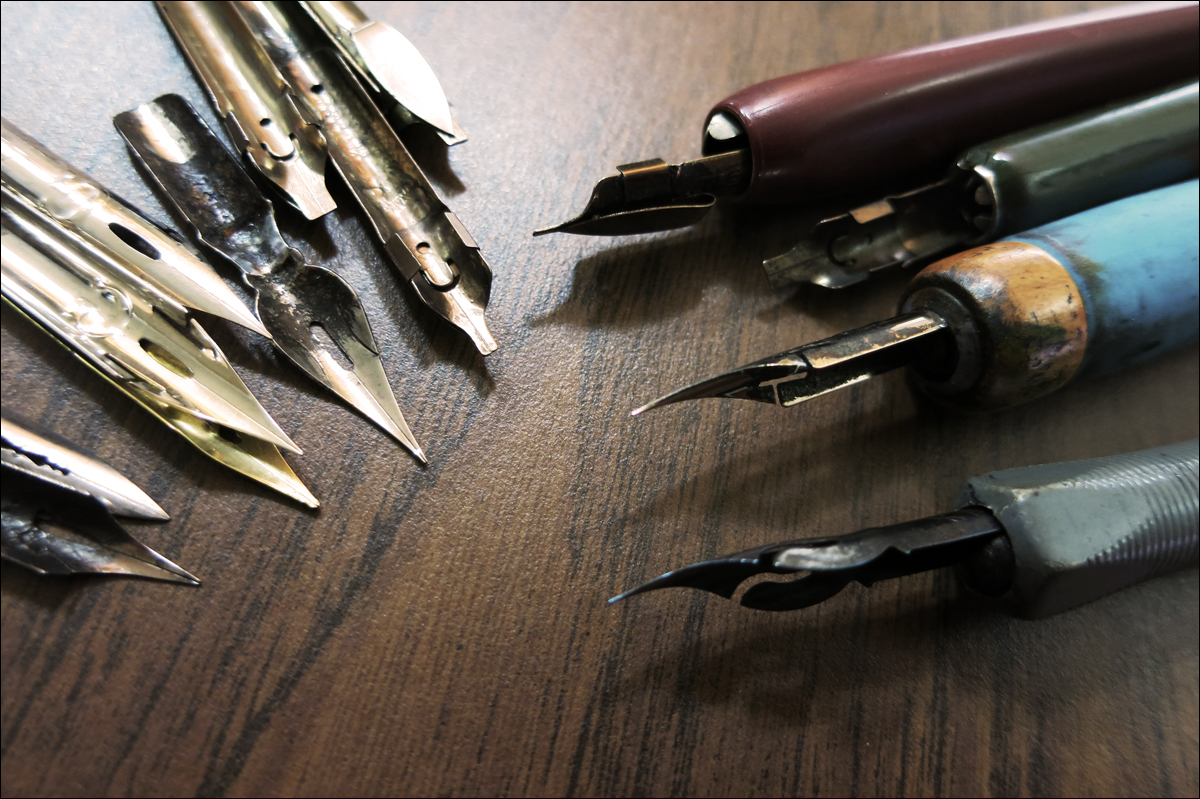
The great thing about nibs – they come in so many sizes and shapes – you can get a whole range of drawing styles for a few bucks. My mainstays (right now) are: a new Japanese crowquill called a “G” nib (used for fine lines). A weird Brause nib called 361 Steno or ‘The Blue Pumpkin’. It’s a larger nib featuring a gunmetal blue finish. It seems to be a bit more flexy, offering a large range of tapering marks. And some chisel tips from Brause in 1 and 2.5 mm, used for bolder brush-like marks. These chisel nibs are the grandfather of the new ‘Parallel Pen’ you may have seen on the market.
Most of these were in the back of a drawer for 20 years, so I have no idea where they came from. But these days they are all available on JetPens.com. Or, if you prefer to shop locally, just look for a stationers with a calligraphy section.

The first thing you’ll notice, drawing with a dipping nib, is the nice range between thick and thin marks you can make. They’re much more responsive than a fountain pen. For me, the next huge discovery is how easy it is to switch colors on the fly. And to jump around between water proof and water soluble on the same drawing. I have a little fleet of jars with different custom ink mixes. It’s like alchemy, combining colors to get a favorite shade.
Yes, you could just carry a fat handful of pens (like my online crush Andrew Tan), but you’d need quite a few fountain pens to cover all the combos of nib styles, colored inks and solubility. I enjoy the elegance and efficiency in this minimal kit of pen nibs.

Shown here: 1 oz (30ml) Nalgene jars (leakproof). Syringe with large bore needle for measuring out ink mixes. ‘Clip-on’ oil painters medium tin that can go right onto a sketchbook or drawing board. I have four of them, from the Guerilla Paintbox brand – these have a rubber seal to prevent leaks.


Doing these ‘research drawings’ side by side with some traditional Lamy pen work had me saying “Time to toss out all the modern conveniences!”.
The only thing holding me back is the issue of mess. There is a much higher risk of ink spots, drips and stained fingers. And perhaps one day a serious spill. But you know, I think the risk is worth it. There is an energy to a messy drawing that I enjoy. I don’t want it to be perfect. If I wanted that, I’d go back to my previous career in digital art.
Next pen drawing outing (not sure when that will be – let me know if you want it soon!) I’m going to try Kiah Kiean’s ancient Chinese trick – filling a bottle with gauze, which is then saturated with ink. I want to see if this makes it spill proof. I’m not sure if it’s going to interfere with loading the pens with enough ink. More on that soon-ish.
~marc