Disha Sahu, interviewed by Marcia Milner-Brage
To paraphrase from Disha Sahu’s blog Inking Nostalgia:
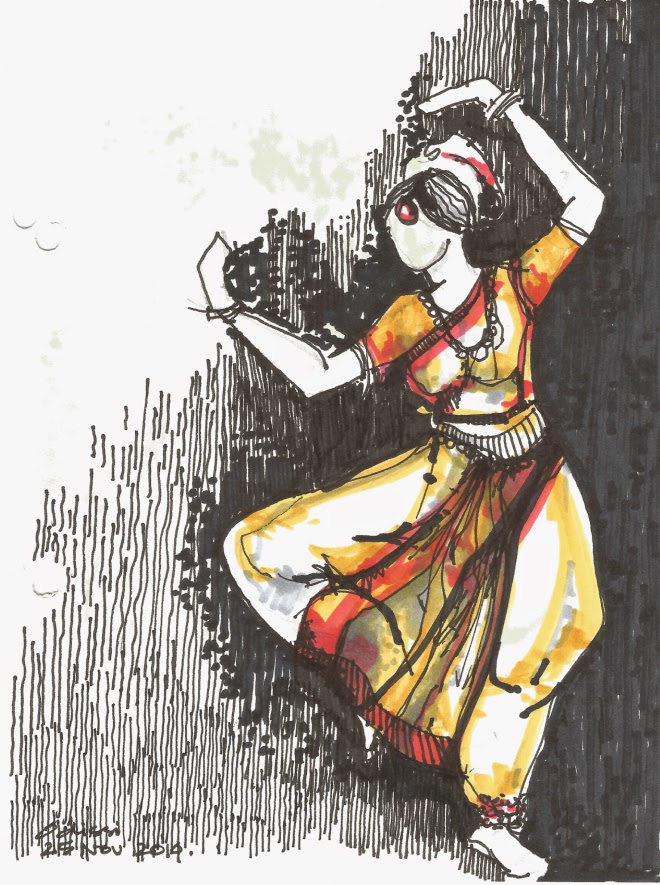
The dialog between drawing and dance can be antagonistic. One tries to freeze a perfect moment, the other glorifies in continual movement. The two art forms are at opposite poles. Not to say that dance doesn’t express stillness. Or that drawing can’t capture motion. But each has its own inherent qualities. I count myself lucky to have the chance to engage with both art forms.


Tell us about the dance that you have drawn.
Kathak is one of the seven Indian classical dance forms. It predominately comes from northern India. Its name Kathak emanates from a Hindi word, “Katha”, meaning story. Thus, Kathak dancers are storytellers. Its form has developed over the last 1500 years. There are varied schools of learning within the discipline, namely Lucknow Gharana, Jaipur Gharana and Banaras Gharana. (Gharana in Hindi means school of thought/learning). The above mentioned Gharanas are named after three Indian cities where these styles developed. As a form, it’s known for its rhythm, synchronised footwork, expressiveness, speed and agility.
Bharatanatyam is another form of Indian Dance. Its tradition comes from the temples of southern India.

Tell us more about your involvement with classical Indian dance.
I pursue Kathak as a hobby. I was introduced to this classical dance form by my mother some fifteen years ago. She saw a creative bent in me and thought it could best manifest through Kathak, so she got me to join the classes. It took me five years to pursue it seriously. And so for the last ten years, I have been practicing it.

How did these drawings come about?
I go to my dance studio to just practice Kathak and relax. I attend a bi-weekly class. These were done in my dance studio, where I observed my co-dancers and did the sketches.

Tell us about how Kathak and Bharatanatyam are performed.
The original Kathak dance was performed by solo individuals. In contemporary context, it’s common to do duet and group performances. Kathak is a dance form which evolved from the royal courts of northern India. Bharatanatyam, which originated in southern India, began as dance as a form of worship. But today, both are more often found in auditoriums, classical dance festivals and art institutions. They are not done in streets or markets. They are not a folk art but a classical art form.
Disha Sahu is an architect based in Bangalore and Delhi, India. In her leisure time, besides dancing Kathak, she likes to sketch, read, travel, do photography, try various cuisines, and indulge in soulful music. She thinks of herself as a traveler with a sketchpad. Follow her BLOG or on Facebook.
