
[Guest post by Marie-Judith Jean-Louis in Toronto] When I moved to Toronto, urban sketching was my way to get acquainted with the city and its people. And in order to relive the great experience I had during my first International Urban Sketchers Symposium, I set out to create and grow an urban sketching community in Toronto.
Toronto is growing at such a rapid rate that even for a relative newcomer like myself, many areas look completely different than they did two years ago. As the city keeps growing and new buildings get erected, some of the landmarks are slowly fading in the background or completely disappearing. Buildings are sentenced to be demolished, and locals are voicing their disappointment and disagreement about the decisions made by the city. Many of the sites have a lot of history, and Urban Sketchers Toronto thought it would be great to capture some of them in an illustrated book. The Toronto Disappearing Landmarks project became a way for us to tell the story of some of these landmarks and for us to connect with some of the history.
The project, open to any sketcher interested in participating, included 21 sketchers who submitted their sketches of various landmarks of the city over the summer, and the book was put together in the fall. Some sketches were made together as a group, and others were done by individuals on their own.
Honest Ed’s
Honest Ed’s (sketch above by Mauricio Munoz) is a landmark discount store with large red signs and screaming for attention with its 23,000 light bulbs. You can’t miss it. The owner, Ed Mirvish, was a European immigrant who achieved great success in Canada through hard work and innovation. He first opened the store Honest Ed’s Bargain House in 1948. The popularity of the store grew quickly and led him to expand the store to take up the entire city block on the corner of Bloor and Bathurst streets.
 |
| Honest Ed’s by Marie-Judith Jean-Louis |
This unique building has a lot of stories to tell. For example, every piece of store signage is hand-painted. Ed Mirvish was known as much for his generosity as for his skill as a merchant. His longstanding tradition of giving away free turkeys at Christmas and Thanksgiving has been continued by his son, David Mirvish. December 2015 marked the end of an era: their 28th and last annual Christmastime turkey giveaway. The iconic store will be replaced with affordable condos and independent shops.
Captain John’s Boat Restaurant
 |
| Captain John’s Boat Restaurant by Barry Stoch |
Captain John’s Boat Restaurant used to be a familiar sight to Torontonians and visitors alike in the Harbourfront area. This unique restaurant was the brainchild of John Letnik, a refugee from FPR Yugoslavia who came to Canada in 1957. After working as a chef, he opened his first restaurant. He then came up with the idea of opening a boat restaurant, which led him to open Toronto’s first floating restaurant in 1970. Five years after that, he bought another boat. Captain John’s Boat Restaurant, docked at the Harbourfront, was Lenik’s second floating restaurant. The ships started the development of the area, transforming the then-industrial port into what is now a major tourist attraction and residential area.
 |
| Captain John’s Boat Restaurant by Amara Strand |
Unfortunately, his first boat sank a couple months after having been struck by a ferry boat. The Captain John Boat remained at the Harbourfront for several years. Falling into disrepair, the boat was to be scrapped. On May 28, 2015, the old ship was towed out of the harbour to begin its final voyage, witnessed by a crowd of several hundred people and an impromptu band. A couple weeks before, several sketchers gathered before its final departure to capture this iconic landmark.
The Cookbook Store
 |
| The Cookbook Store by Patricia DaSilva |
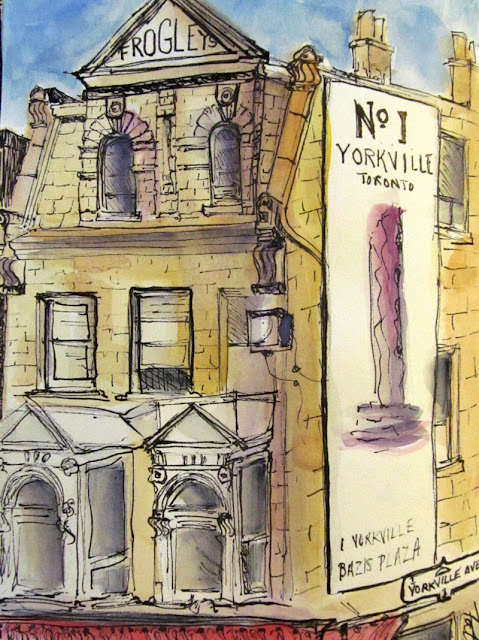
Sitting on the corner of Yorkville Avenue and Yonge Street, The Cookbook Store was a place where you could run into famous foodies such as Julia Child, Anthony Bourdain and Nigella Lawson. For over 31 years, cooking enthusiasts had a destination where they could find like-minded individuals, books and various items related to food and cooking. The store was the idea of Dr. Josh Josephson, a retail pioneer who jumped into a narrow niche and opened The Cookbook Store in the old Frogley Building.
 |
| The Cookbook Store by Nora MacPhail |
The Frogley Building’s food connection doesn’t start with The Cookbook Store. Charles J. Frogley bought the building in 1885 and operated a confectionery store and bakery. We’re not quite sure exactly how old the building is, but it’s well over 100 years old. When we went out to sketch the building, we could still see the “Frogley’s” name on the top of the building, but the signage of the Cookbook Store was long gone. Brown paper was already covering the window. Fortunately, a couple months before construction began, one sketcher had a chance to sketch the building. This centenarian building will soon make way for a 58-story residential building.
Urban Sketching Disappearing Landmarks in Toronto contain sketches from 21 Toronto urban sketchers. It was a great opportunity to collaborate on a project together and is a great memento of our summer together. The book is available at Amazon.com.
Marie-Judith Jean-Louis is a curious artist based in the city of Toronto. She’s the founder of the Toronto Urban Sketchers and the Toronto Real podcast. You can find out more about her at mariejudith.com.