By Marc Taro Holmes in Montreal, CA
The other day I was sketching at the C2 Conference here in Montreal, and found myself drawing while simultaneously contemplating the death of work in our upcoming automation based economy, and the role of artists after the singularity.
(If you believe in either of those theories).
C2 is a place where you might find yourself believing all that stuff after a few lectures 🙂
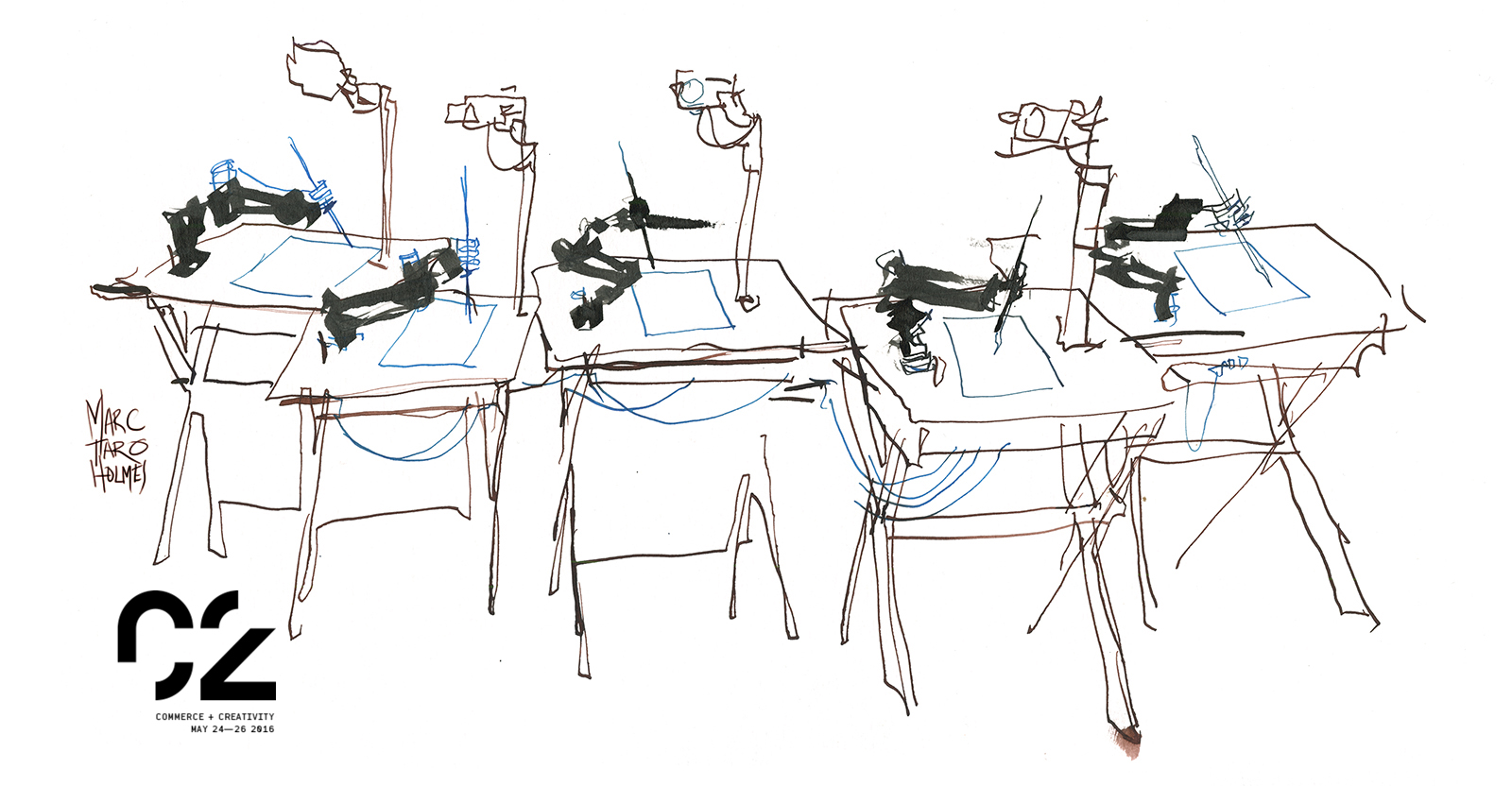
 https://citizensketcher.files.wordpress.com/2016/05/16may31_robot_drawing_011.jpgWhat I was actually doing, while thinking these deep thoughts, was drawing a gang of drawing robots, while they were drawing a live human model.
An odd feeling for sure!
These small robot arms are built and programmed by artist Patrick Tresset.
Each robot has a camera “eye” and some techno wizardry in its processor brain that converts the values the camera sees into densities of pen marks. The results are actually fairly similar to what human artists do – since of course these robots were programmed by an artist who knows how to draw.
When I passed by, the group of about a half dozen arms were part way through their drawings, so I quickly pulled out my own sketching material to see if I could beat them to the punch.

I was only drawing for a few short minutes, but in that time a number of hilarious things happened.
First, I was in such a rush to beat the robots that I spilled some ink on the gallery floor. I’m in the habit of flicking dirty brushes onto the ground when I paint outside – and in my rush I did it without thinking. Luckily it was a polished concrete floor – so I could just casually drop a bit of paper towel and stand on it while I drew, mopping secretly.
Immediately after, I was digging in my bag for a pen nib or something, and I cut my finger. Painfully jamming a hangnail on the edge of a drawing board and ending up leaking blood down my finger tip while juggling multiple wet ink drawings.

I could see the half dozen robot arms working relentlessly while I fumbled.
They would never need a break. Never get distracted, never cut their fingers, never spill their ink.
There is no way to avoid seeing the obvious parallels in the larger global economy. This is what all those auto plant workers or deep sea welders, or the fabled John Henry must have felt like.
But I’m an artist – I was so sure this didn’t apply to me! Supposedly I am the one thing that cannot be replaced by a machine – and here I am being forced to confront my human frailty in this one sided drawing contest with a bunch of mechanical back scratchers bolted onto grade school desks.
But then, as I was turning the corner in my imaginary sketching race, well ahead of the sluggish robot team, I was congratulating myself on starting late and finishing early – totally owning those wind up toys – when I noticed a bit of programmatic theater.
The robot cameras were actually bobbing their heads, like an artist does.
Looking down at the paper then up to the human subject, then down again at the paper. A gesture any artist will recognize from life drawing class.
It was then I realized the true (terrible) nature of the situation.
There is no way the robots were actually analyzing their drawings visually. That would simply take too much artificial intelligence. I am techy enough to know this could not be the case here. It has to be a simple one-shot image analysis algorithm.
That means the camera head-bob was programmed in to make it *look* like the arms were thinking about the drawing.
In fact – the entire process of the pens scratching away while the model tried not to fidget? That was total mummery. A puppet show designed to entertain the humans. Look how cute the robot overlords are!
The human didn’t have to hold still! He could have walked away at any time! The robots only need a single glance to capture the likeness of our model (Mr. John Farquhar-Smith of FLUX). (I’m not sure he wasn’t a ringer working for the robots).
In fact – the robots don’t need time to do these drawings at all!
They could have executed them in a blur of motion, so fast they melted the ball point pens. They could have extruded the final drawing as a single stamped shape in a millisecond. They could probably have 3D printed a clone of John’s DNA in the time it took me to figure out how badly I was actually losing this race.
This fantasy that I was speeding past the machines was just a bit of re-assurance Mr. Tresset is trying to allow me. A bit of salve to my ego. I might have walked away thinking – those robots will never replace me! I’ve chosen the one path that is future proof.
But instead, I’ve walked away knowing – it’s only a matter of time until making imagery by hand is a Luddites’ pastime. A poet’s licence.
Eventually, all of us will have to consider what automation means to us. And I suppose, we’ll have to decide how much we care.
For now I can see the humor in it all. But I wonder what I’ll really be thinking in the next decade? It’s going to be interesting times ahead!
~m